
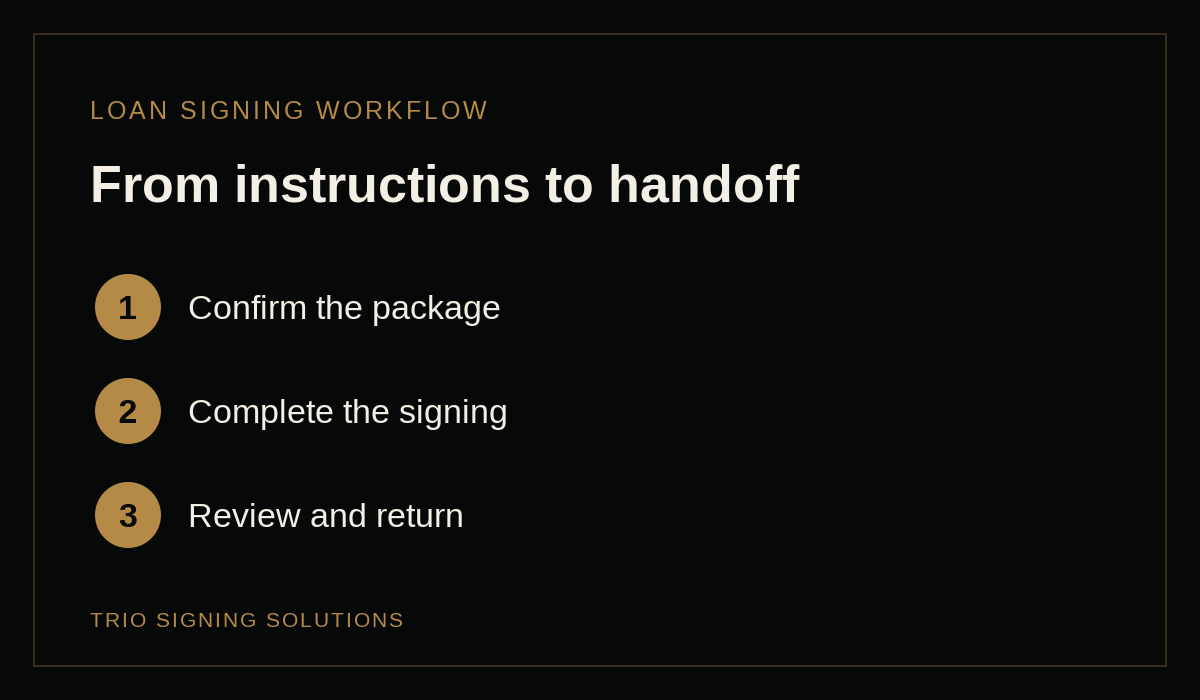
A successful loan signing depends on decisions made before the notary arrives. The correct package, clear instructions, available decision-makers, and a realistic return plan help title professionals avoid preventable interruptions. A well-organized appointment also gives borrowers room to ask questions without turning the signing agent into a substitute for the lender or closing attorney.
This guide follows a practical workflow from scheduling through document return. It is intended for title and settlement professionals coordinating mobile loan signings across different locations. State requirements, lender instructions, transaction documents, and recipient acceptance control the details. This is operational education, not legal, lending, or financial advice; use your authorized professionals to resolve transaction-specific questions.
1. Assign ownership before confirming the appointment
Start with a brief that identifies the transaction, property, signing location, required participants, and preferred appointment window. Separate the person arranging the appointment from the person authorized to approve document changes. An appointment contact might be able to confirm a gate code without having authority to resolve a discrepancy in the deed or loan terms.
Record the lender contact, title or settlement decision-maker, and backup contact with their availability. Specify who answers borrower questions about loan terms, who reviews execution issues, and who authorizes revised documents. Where an attorney must supervise or conduct a closing, confirm the required arrangements before assigning a notary. Nationwide coverage does not make state closing practices interchangeable.
Define the signing agent's scope in writing. The agent can guide the appointment through the supplied package and perform authorized notarial acts, but should not choose legal language, recommend a loan, or explain the legal consequences of a document. The title team's responsibility is to make the right expert reachable when that boundary matters. Review Trio's coordination process when planning the handoff.
- Title team confirms scope
- Lender and settlement contacts assigned
- Signing agent receives approved instructions
- Questions return to the responsible professional
2. Release one controlled version of the loan package
For example, if the lender replaces a note and disclosure after the original package has been printed, send a replacement notice that names both documents. Specify whether any related instructions also changed. Ask for confirmation that the old pages will not travel to the appointment. Keep the final version reference with the order so the reviewing team can compare the returned set against the package actually released.
Treat the package as a controlled release rather than a collection of email attachments. Give the approved set a clear version label and communicate whether a later delivery replaces the whole package or only specified pages. Tell the agent to acknowledge receipt of the replacement and remove superseded working copies from use through your approved secure process.
Before release, check page count, readability, page size, required attachments, signature locations, and the correspondence between borrower names and the instructions. Flag mixed letter and legal pages. A page that appears complete on a screen can lose a signature line when printed with the wrong scaling. Avoid instructions that require the agent to guess which version is current.
Have the lender or authorized settlement professional resolve substantive inconsistencies. The CFPB's document-review guidance encourages borrowers to check closing documents and raise questions before signing. Build that review opportunity into the schedule instead of expecting the signing appointment to absorb every unresolved issue.
3. Confirm readiness without promising eligibility
A confirmation call should establish the exact address, parking or entry arrangements, everyone expected to attend, and a practical workspace. Ask whether accessibility, language, travel, or scheduling needs require advance coordination. Share relevant requirements through the authorized team rather than assuming a family member can translate, witness, or sign for someone else.
Remind participants to have identification that meets the applicable notarial requirements. Do not promise that any particular document will be accepted before the notary assesses it under the governing rules. Name discrepancies, expired identification, missing signers, and representative signatures deserve early attention. A power of attorney requires transaction-specific review and acceptance by the responsible parties, not an informal assurance from the appointment scheduler.
Offer the borrower a preparation resource such as what to bring to a notary appointment. Keep the message simple: allow adequate time, keep required documents available, and contact the team about uncertainty before the appointment. Preparation reduces wasted travel while protecting the notary's independent responsibility to determine whether the requested act can proceed.
4. Keep disclosure timing with the responsible lender
An available signing time is not confirmation that every disclosure requirement has been satisfied. Establish who verifies that the transaction is ready for execution and who communicates approval to proceed. The signing agent should receive that instruction through the agreed channel, without being asked to decide whether a disclosure was legally delivered or a waiting period has expired.
For transactions subject to the relevant rule, the CFPB's TRID FAQs explain Closing Disclosure receipt timing and the circumstances governing corrected disclosures. The lender and appropriate compliance professionals should apply those rules to the file. Avoid presenting a general three-day statement as a complete scheduling rule for every mortgage or document change.
If revised figures or documents arrive shortly before the appointment, ask the responsible professional whether the appointment remains authorized and whether the borrower needs additional review time. Record the answer and distribute the current instructions. A clear pause can protect the transaction more effectively than a rushed appointment followed by a second trip.
5. Support correct execution and independent notarization
During the appointment, the agent should work systematically through the approved package, following lawful instructions for signatures, initials, dates, and notarial certificates. Package familiarity helps the agent identify where a borrower should direct a question, but it does not authorize legal interpretation. Questions about interest, payment obligations, title ownership, vesting, or the effect of a waiver belong with the responsible professional.
Identity, personal appearance, willingness, and any required assessment of awareness must be addressed under the applicable jurisdiction's rules. Pressure from a deadline or another participant cannot replace the conditions required for notarization. If a signer appears unwilling or cannot participate as required, the notary should pause and follow the governing law rather than allowing a coordinator to override the concern.
Notarial acts are not interchangeable. An acknowledgment and a jurat involve different requirements; see jurat versus acknowledgment. For a state-specific example, the California Secretary of State's current handbook addresses identification, certificates, and incomplete documents. Other states have their own requirements, so a national instruction sheet must leave room for lawful local practice.
6. Use a defined exception and correction process
Make the stop-and-escalate process specific. Examples include a missing document, inconsistent names, an absent required signer, an unclear certificate, incorrect figures, or a borrower who disputes a term. Ask the agent to identify the page and issue, preserve the document as received, and reach the designated contact. A vague message that the package has a problem creates avoidable back-and-forth.
The authorized professional should determine whether to replace a page, redraw documents, obtain additional review, or reschedule. Corrections must follow applicable law and written instructions. Never request backdating, a certificate for an absent signer, or an assumption that an earlier signature can simply be notarized in any manner. Our guide to documents signed before a notary appointment explains why the requested act matters.
Record who authorized the resolution, when it was communicated, and exactly which pages changed. If the appointment ends incomplete, report the completed and outstanding portions separately. Preserve a factual record without speculative commentary about the borrower. A useful exception report lets the next person act without reconstructing the entire appointment.
- Identify the exact issue
- Pause the affected step
- Contact the authorized decision-maker
- Receive lawful documented instructions
- Report the final outcome
7. Plan scanbacks and protect borrower information
Confirm scanback requirements before the appointment, including required pages, delivery channel, review deadline, and whether originals must be held pending release. Set expectations around connectivity and scanning access. Requiring a full package immediately after an appointment without discussing the return plan can create an operational deadline the agent cannot reasonably meet.
Use the company's approved secure portal or other authorized protected channel. Limit access to people who need the documents, verify recipients, and keep files out of personal messaging accounts or shared household storage. The FTC's business guidance on protecting personal information recommends understanding where sensitive information travels, limiting retention, and protecting information during transmission. Apply your organization's security and retention policies to working copies and devices.
Keep money-transfer instructions within the settlement team's established verification process. A last-minute email should never become an instruction for the signing agent to validate or change payment destinations. The CFPB's mortgage-closing fraud guidance recommends confirming wiring details through trusted representatives using previously established contact information. Tell participants how to reach that verified channel before urgency develops.
8. Separate signing completion from funding and recording
Consider a late-afternoon appointment with required scanback approval before shipping. The coordination plan needs an available reviewer, time to correct an execution omission lawfully if necessary, and a carrier option that remains open. If those pieces do not align, discuss the consequence before confirming the appointment. Do not quietly convert a preferred return time into a guarantee that the team cannot control.
Use precise status descriptions. Appointment completed means the appointment occurred; package returned means the documents reached the designated destination. Neither statement alone confirms that the lender has authorized funding, that settlement has disbursed money, or that an instrument has been accepted for recording. Those events have different owners and may occur at different times.
Before originals leave the agent's possession, follow the agreed review and release instructions, confirm the destination, and record tracking information when a carrier is used. Account for carrier cutoffs, weekends, holidays, and local collection times when choosing the appointment window. The correct document set delivered after an essential cutoff can still disrupt the transaction timetable.
Provide the receiving team with a concise status: appointment result, known exceptions, scanback submission, release authorization where required, and original-package tracking. The receiving professional should complete their own review. Do not describe a loan as funded, recorded, or ready for possession merely because the borrower has signed. Clear labels prevent downstream teams from acting on an assumption.
- Signing result reported
- Scanbacks reviewed as instructed
- Originals returned and received
- Authorized teams confirm funding and recording separately
9. Build a repeatable partnership for nationwide signings
Measure the parts of the process your team can improve: how often revised pages arrive after printing, how quickly an authorized contact answers an exception, and whether return instructions are clear on the first release. Separate a preventable omission from an appropriate pause for signer protection. An agent who stops for a legitimate concern should not be treated as though speed mattered more than a proper execution.
Standardize the essentials while allowing file-specific instructions. A reusable brief can capture contacts, signer needs, package version, printing requirements, escalation rules, scanbacks, and return deadlines. Review recurring exceptions to identify whether they begin with package preparation, appointment confirmation, or an unclear handoff. The objective is fewer repeated problems, not simply more status messages.
Trio Signing Solutions coordinates notary signing support nationwide. Explore support for title teams and mobile loan signing services to discuss your locations, volume, and workflow. Share timing, package delivery, and reporting expectations when requesting an appointment so the coordination plan reflects what your file actually needs.
For transactions with unusual execution requirements, raise those details before scheduling. Trio can help coordinate the signing appointment while your lender, settlement team, and legal professionals retain their decision-making responsibilities. Review our services or contact Trio with the location, preferred timing, and scope. Confirm availability and requirements rather than assuming that any appointment format will suit every transaction.
Frequently asked questions
Who should resolve a borrower question about loan terms?
The lender or another authorized transaction professional should address substantive loan questions. A signing agent can identify the relevant document and help contact that professional, but should not recommend a loan or interpret legal obligations.
Does a completed loan signing mean the loan has funded?
No. Signing, document review, funding, disbursement, and recording are separate milestones. The responsible lender and settlement professionals should confirm the status of each applicable step.
What should title teams include in signing instructions?
Include the current package version, participant and appointment details, printing requirements, authorized escalation contacts, scanback instructions, original-document return instructions, and relevant deadlines. Identify any state-specific or transaction-specific requirements for advance review.
Can a title team ask a notary to proceed without acceptable identification?
A coordinator cannot waive the identification rules governing a notarial act. The notary must follow applicable law. Escalate identification concerns early so the responsible parties can consider lawful options before the appointment.
Put the next signing in motion.
Share the document type, location, timing, and any instructions so Trio can help coordinate the next step.
EXPLORE TITLE TEAM SUPPORT
