

Short answer: not for every family member. In Florida, a notary may not notarize a signature for their spouse, son, daughter, mother, or father. Even when a relative is not named in that list, the notary must not have a financial interest in the transaction or be a party to it. The practical answer for a family document is usually simple: choose an unrelated, neutral notary before anyone signs.
That choice protects everyone. A notary’s job is to identify the signer, confirm the requested act, and make sure the signer appears willing and aware. Family relationships can complicate that impartial role, especially for estate, property, healthcare, or financial documents. This article explains the Florida rules at a high level. It is general information, not legal advice. The document recipient or a qualified attorney should answer any question about what the document itself requires.
Florida names the relatives a notary cannot serve
Florida law is direct about several close family relationships. A notary public may not notarize a signature when the signer is the notary’s spouse, son, daughter, mother, or father. The restriction applies to the signer whose signature needs the notarial act. It is not something a family can waive because the document seems routine or everyone agrees.
The state’s prohibited-act statute places this restriction alongside other situations in which a notary must stop, including an absent signer and an incomplete document. Florida’s published notary frequently asked questions also notes a narrow marriage-certificate exception. Do not stretch that exception to another document type. For ordinary family paperwork, use another notary.
This is not just a technical detail. A neutral appointment helps the signer, the recipient, and the notary avoid a question later about whether the notarization was handled correctly. It also lets the notary focus on the required identity, appearance, willingness, awareness, and certificate steps without a close family relationship in the middle.

What about siblings, grandparents, or extended family?
Florida’s statute specifically names a spouse, son, daughter, mother, and father. It does not answer every possible family relationship by name. That does not mean every other relative is automatically a good fit for the notarization. The next question is whether the notary has a financial interest in, is a party to, or cannot be impartial about the underlying transaction.
For example, a sibling may not be listed in the family restriction, yet the notary could still have a direct stake in a family property sale, an estate distribution, a business deal, or a power of attorney. The notary should not perform the act when they stand to gain from the transaction or are a party to it. A close relationship can also make it difficult to assess willingness and awareness without assumptions.
When the situation is personal, valuable, contested, or simply unclear, there is no advantage in trying to find the narrowest possible exception. Use a neutral notary. That gives the document recipient a cleaner record and gives the family one less issue to revisit later.
A family document can involve more than one concern
A family relationship is only one part of the appointment. The signer still needs to appear for their own notarization, provide satisfactory identification under the rules that apply, and sign or acknowledge the document in the required sequence. The document must be complete, and the notary must be satisfied that the signer understands the nature and effect of what they are signing.
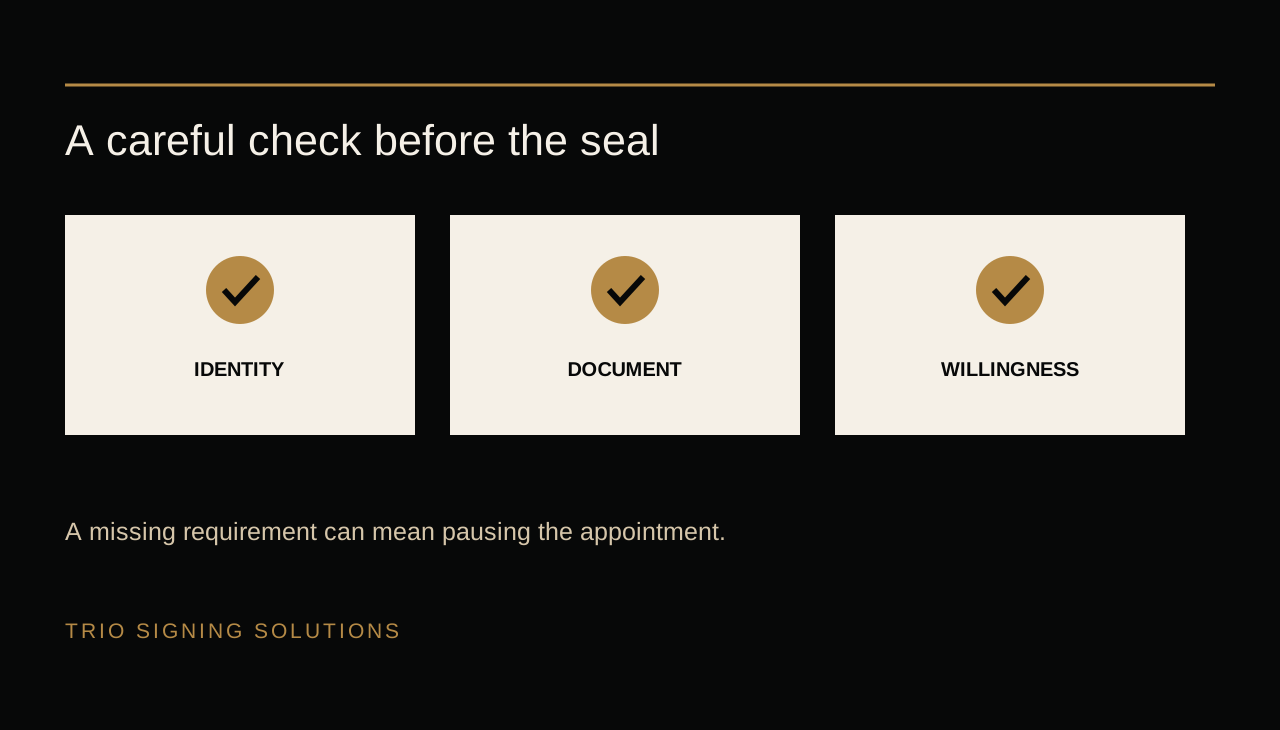
That matters in situations where a relative is helping an older parent, coordinating paperwork from another city, or managing a time-sensitive estate document. Helping with logistics is different from directing a signer or asking a notary to overlook a concern. If the notary has doubts about identity, willingness, awareness, completeness, or the requested notarial act, the appointment may need to pause.
Trio’s guide to common reasons a notary may refuse a notarization explains the practical checks that can prevent a difficult or unsuccessful appointment. Those checks are there to protect the signer as much as the paperwork.

Estate, property, and authority documents deserve extra preparation
Wills, deeds, powers of attorney, healthcare documents, trusts, and similar paperwork often involve family members. They may also carry special witness, signing-order, or recipient requirements. The fact that a document is important does not make a relative’s notarization acceptable, and it does not authorize the notary to choose a certificate or explain the document’s legal effect.
Before scheduling, ask the attorney, title company, agency, court, healthcare provider, or other recipient what it requires. Confirm which signatures need notarization, whether witnesses are needed, whether everyone must be together, and whether the recipient has a specific certificate or timing instruction. If the document comes from another state, confirm that it will accept a Florida notarization and what must appear in the notarial certificate.
For example, two adult relatives may each have a separate signature to notarize. They may be able to use separate appointments, but the recipient decides whether that sequence works for the document. Trio’s guide to multiple-party notarizations helps separate the people who need to appear from the people who are simply parties to the broader transaction.
Common family situations and the safest next step
A parent asks an adult child who is a notary to help. In Florida, the child cannot notarize the parent’s signature. Arrange a different notary before the appointment. The same rule applies in the other direction, from a parent who is a notary to an adult child signing a document.
A spouse needs a routine form notarized. The document’s importance does not change the restriction. Even a school, insurance, or banking form should go to a neutral notary if the signer is the notary’s spouse. Bringing the complete form and a current photo ID will help the alternative appointment move quickly.
A sibling is handling a family estate. A sibling is not specifically listed in Florida’s immediate-family restriction, but estate paperwork can create a financial interest or a question about impartiality. If the notary might benefit from the estate, is named in the transaction, or feels too close to assess the situation independently, they should step aside. A neutral notary is the cleaner choice.
A relative is helping a signer who is ill, older, or under stress. The helper can organize the document packet, schedule the appointment, and make the setting comfortable. The signer must still personally appear, show acceptable identification, understand the document at the time of notarization, and act willingly. Give the notary time to speak with the signer and complete the required checks without pressure.
A family member wants to sign for someone else. A relationship alone does not let one person sign or appear in place of another. Some documents may authorize an attorney in fact, trustee, guardian, or corporate representative to sign, but the recipient or qualified attorney should confirm that authority and the correct signature format before the appointment. The notary cannot decide whether someone has legal authority simply because the people are related.
Why a neutral notary is the practical choice
Using someone outside the family is not a sign that anyone distrusts the signer. It is a straightforward way to keep the notarization independent. The notary can concentrate on the signer’s identity, the required appearance, the certificate, and whether the signer appears willing and aware. The family can concentrate on the document’s instructions and the next step after notarization.
That separation is particularly valuable when a document will be recorded, reviewed by a title company, submitted to a court, or relied on later by an institution. A neutral notarization does not guarantee that every document will be accepted, because the recipient may have its own rules. It does remove one avoidable concern from the process. If the document is rejected for a separate reason, the family has a clear record that the notarial appointment itself was arranged with independence in mind.
It can also make the appointment calmer. A mobile notary can meet the signer at a home, care setting, office, or other appropriate location. For an eligible remote session, a neutral online notary can complete the authorized process without requiring a relative to serve in two roles at once. In either case, confirm the recipient’s instructions before scheduling, especially when witnesses or original documents are involved.
Remote notarization does not remove a conflict
Remote online notarization can be helpful when an eligible signer cannot travel, but it does not change the notary’s obligation to follow Florida restrictions. A prohibited family relationship or financial interest remains a problem whether the signer is across the table or on a live audio-video session.
Remote availability is also not automatic. The signer, document, notarial act, platform process, witnesses, and recipient acceptance all need to fit. A casual video call does not replace an authorized online notarization. If an online appointment may be appropriate, confirm acceptance first. If an in-person visit is better, arrange a neutral mobile notary who can meet the signer in a calm, private location.
How to set up a clean, neutral appointment
- Identify the signer and the document recipient. Confirm who needs a notarized signature and who will receive the completed document.
- Choose an unrelated notary when the relationship is prohibited or uncertain. This is especially important for estate, property, healthcare, or financial documents.
- Ask about witnesses and signing order. The recipient or attorney, not the notary, should answer a legal-document question.
- Keep the document complete. Bring every page, attachment, and instruction sheet. Do not present a blank or incomplete document for notarization.
- Prepare the signer. Have current identification ready, allow time for the appointment, and make sure the signer can speak privately and make their own decisions.
For the rest of the practical checklist, review Trio’s guide to preparing for a notary appointment. A complete packet and clear recipient instructions are often the difference between a smooth visit and a second appointment.

State rules still matter outside Florida
Notary rules vary by state. A person who reads general advice online may find a different list of prohibited relatives, a different conflict standard, or a different remote-notarization rule. The relevant law is usually the law where the notary is commissioned and performs the act, not merely where a family member lives or where the document will be used.
For a Florida appointment, start with Florida requirements and then check the recipient’s instructions. If a signer must complete the act in another state, use a notary authorized there. If an out-of-state document will be signed in Florida, its destination does not automatically prevent a Florida notarization, but its recipient may have specific acceptance requirements. Trio’s article about documents from another state explains that distinction.
How Trio can help
When family paperwork needs careful coordination, Trio can help arrange a professional mobile or eligible remote appointment with a neutral notary. Share the document type, signer location, timing, required witnesses, and recipient instructions when you request service. That information helps the team plan the right appointment without asking the notary to make a legal decision.
Once the document’s requirements are clear, explore Trio’s notary services or request a signing. If there is any question about the document’s certificate, witnesses, or legal effect, ask the recipient or a qualified attorney before the appointment.
Frequently asked questions
Can a Florida notary notarize for a spouse, parent, or child?
No. Florida law says a notary may not notarize a signature when the signer is the notary’s spouse, son, daughter, mother, or father. Use a neutral, properly commissioned notary instead.
Can a Florida notary notarize for a sibling or another relative?
Florida’s statute specifically lists a spouse, son, daughter, mother, and father. Other relatives may raise a different question: whether the notary has a financial interest in, is a party to, or cannot be impartial about the transaction. When there is any uncertainty, a neutral notary is the safer choice.
Can a notary notarize a family member’s will, deed, or power of attorney?
The document type does not remove Florida’s family-member restriction or conflict rules. Estate, property, and authority documents can also have their own witness, signing, and recipient requirements. Confirm those details with the attorney or organization that prepared or will receive the document, then use an unrelated notary when needed.
Does remote online notarization change the family-member rule?
No. A remote session changes the method of appearance when it is eligible and accepted, not the notary’s duty to follow Florida restrictions and avoid conflicts. A neutral remote or in-person notary may be the appropriate option.
Related posts
Notary Basics
Can a Notary Refuse to Notarize a Document? Common Reasons Explained
Understand notary requirements and common reasons a notary refuses notarization, from missing ID to incomplete documents and concerns about consent.
Read the guide →
Notary Basics
Do Both Parties Have to Be Present for a Notary?
Learn who needs to appear for notarization, when multiple signers can use separate appointments, and what to confirm before you schedule.
Read the guide →
Notary Basics
What to Bring to a Notary Appointment
A practical checklist for your document, identification, signers, witnesses, and the details that prevent an avoidable delay.
Read the guide →